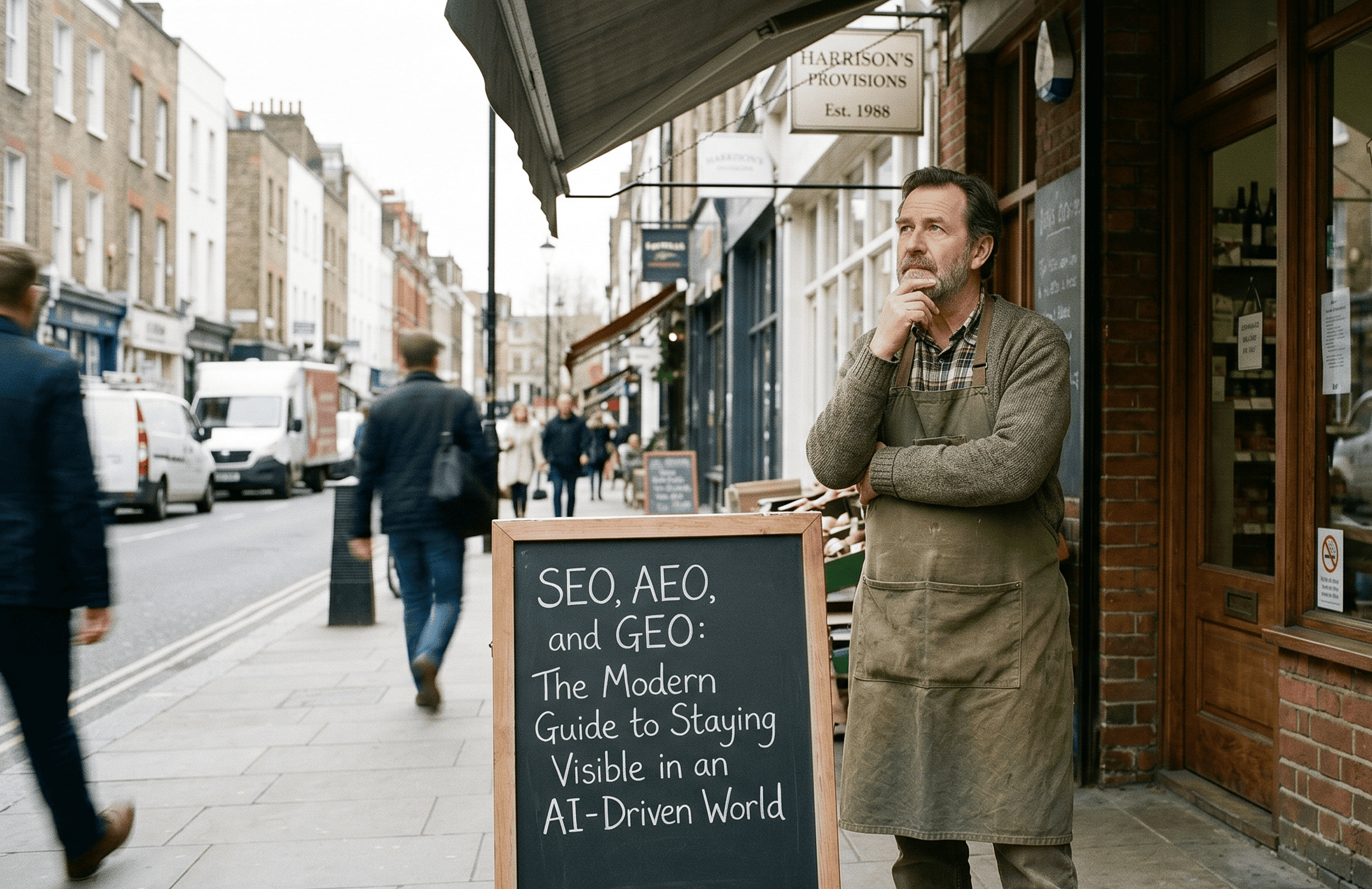
You have spent years mastering SEO, getting your website to rank on the first page of Google. Now, suddenly, there are new acronyms appearing in every marketing meeting: AEO and GEO. You might be asking yourself, “Are these just fancy new ways to describe the same work, or have the rules of the game changed entirely?”
What You’ll Learn
- Defining the core differences between SEO, AEO, and GEO.
- How these three disciplines work together rather than against each other.
- Why the modern search ecosystem requires a “Search Everywhere” strategy.
- Practical steps to start optimising for this new, hybrid search reality.
Introduction
The digital search ecosystem is no longer just a list of blue links. It has become a complex, AI-driven environment where users ask questions to voice assistants, request summaries from chatbots, and interact with intelligent search features. To maintain visibility, marketers must move beyond traditional Search Engine Optimisation (SEO) and embrace Answer Engine Optimization (AEO) and Generative Engine Optimization (GEO). While their goals—to capture attention and drive results—remain aligned, the tactics used to reach them have evolved significantly.
Defining the Pillars of Modern Search
- SEO (Search Engine Optimisation): This is the foundation. Its primary goal is to ensure your website ranks as high as possible in traditional search engine results pages (SERPs). Tactics focus on backlinks, keyword density, technical performance, and site architecture to earn clicks and traffic.
- AEO (Answer Engine Optimization): AEO is the art of getting your content picked as the direct answer. When a user asks, “How do I fix a leaky tap in Doncaster?” and a snippet appears with the exact steps, that is AEO in action. It focuses on clarity, structured data (Schema), and concise, question-based content formatting.
- GEO (Generative Engine Optimization): GEO is the next frontier. It is the practice of ensuring your brand is trusted and cited by AI models like ChatGPT, Gemini, or Perplexity. When an AI generates a comprehensive summary and mentions your brand as an expert, you have succeeded in GEO. It relies on topical authority, brand sentiment, and being a source of truth across the web.
Are They Different or the Same?
The short answer is: they are distinct tactics under the same umbrella.
They are not mutually exclusive. In fact, they are deeply interconnected. Traditional SEO provides the technical authority that search engines need to trust your content in the first place. Without a strong SEO foundation, your content is less likely to be considered for an AI-generated answer (AEO) or cited by an LLM (GEO).
Strategy | Primary Goal | Focus Area |
SEO | Rank in search results | Keywords, Backlinks, Technicals |
AEO | Win the featured snippet | Structure, Direct Answers, Schema |
GEO | Earn AI citations | Topical Authority, Mentions, Trust |
Why You Need a “Search Everywhere” Strategy
Relying on traditional SEO alone is becoming increasingly risky. As more users turn to AI tools for research and decision-making, you need your brand to appear in every environment where your customers are asking questions. A successful strategy acknowledges that:
- SEO gets you the click.
- AEO gets you the authority.
- GEO gets you the trust.
Conclusion
Do not let the new acronyms overwhelm you. SEO, AEO, and GEO are simply the latest chapters in the evolution of digital search. By ensuring your content is technically sound, structured for quick answers, and authoritative enough to be cited by AI, you are not just keeping up with trends—you are future-proofing your business.
How to Take the Next Step
Are you ready to adapt your strategy to the AI-first search world? We help businesses in South Yorkshire navigate the complexities of modern search, from technical SEO to brand authority building.
Explore our Digital Marketing Services and let us help you stay visible everywhere.